← Weekly problem

Week 1 problems

Week of November 2, 2026. Try it first, then open the answer.

Grade 1

The double count

Eli counted 14 blocks. But he counted 2 of the blocks two times. How many blocks are there really?

Need a hint?

Each block that was counted twice added one extra count.

Show the answer

12 blocks

  • Eli said 14, but 2 of those counts were extra.
  • Take the extra counts away: 14 − 2 = 12.
  • So there are really 12 blocks.

Common mistake: Adding the 2 instead (16), as if the double counts were more blocks.
Grade 2

Hundreds in disguise

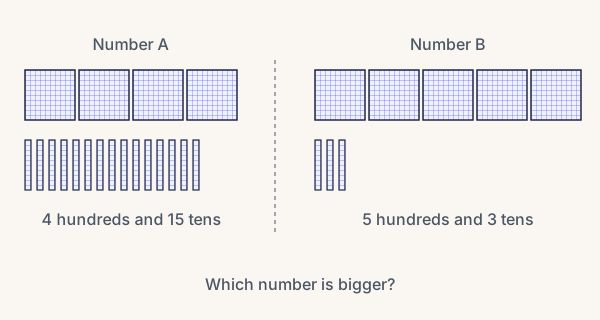
Number A is 4 hundreds and 15 tens. Number B is 5 hundreds and 3 tens. Which number is bigger?

Base-ten blocks. Number A: 4 hundred flats and 15 ten rods. Number B: 5 hundred flats and 3 ten rods.
Need a hint?

15 tens is more than 1 hundred. Trade 10 of the tens for a hundred.

Show the answer

A is bigger: A is 550 and B is 530

  • 15 tens is 10 tens and 5 tens, and 10 tens make 1 hundred.
  • So A is 4 hundreds + 1 hundred + 5 tens = 5 hundreds and 5 tens = 550.
  • B is 5 hundreds and 3 tens = 530.
  • 550 is more than 530, so A is bigger.

Common mistake: Looking only at the hundreds (4 and 5) and picking B.

Grade 3

Even times anything

Kenji multiplies two whole numbers. One of them is even. He says the answer is 35. Can that be right?

Need a hint?

Try a few: 2 × 5, 4 × 3, 6 × 7. What do the answers have in common?

Show the answer

No

  • An even number is made of pairs: 4 is 2 pairs, 6 is 3 pairs.
  • 4 × 7 means 7 groups of 4, and each 4 is 2 pairs. The answer is all pairs, so it is even. Even times anything is even.
  • 35 is odd: 17 pairs and 1 left over. So an even number can never be one of Kenji's factors.
  • Check: the only ways to make 35 are 1 × 35 and 5 × 7, and all of those are odd.

Common mistake: Hunting for Kenji's two numbers instead of asking what kind of answer an even number always gives.

Grade 4

One true sign

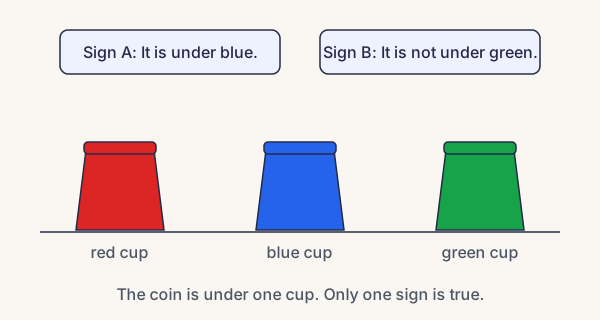
A coin is under the red cup, the blue cup or the green cup. Sign A says: "It is under blue." Sign B says: "It is not under green." Only one sign is true. Where is the coin?

Three cups in a row, red, blue and green, under two signs. Sign A: It is under blue. Sign B: It is not under green.
Need a hint?

Try each cup. For each one, count how many signs would be true.

Show the answer

Under the red cup

  • If it is under blue, both signs are true. That is two, so no.
  • If it is under green, both signs are false. That is zero, so no.
  • If it is under red, Sign A is false and Sign B is true. Exactly one, so yes.
  • The coin is under the red cup.

Common mistake: Believing Sign A without testing the other cups.

Grade 5

Pulling socks

A drawer has lots of black socks and lots of white socks. In the dark, what is the fewest socks you must pull out to be sure you have a matching pair?

Need a hint?

Think about the unluckiest first two socks you could pull.

Show the answer

3 socks

  • With 2 socks you might be unlucky: one black and one white.
  • The third sock has to be black or white, so it matches one of them.
  • 3 socks always gives a pair, and 2 does not, so 3 is the fewest.

Common mistake: Saying 2, which only works if you are lucky.

Get next Monday's problem

One problem for your child's grade, every week. Free.

Free. One email a week. Unsubscribe any time.

Weekly Math Problems, Week 1: Answers for Grades 1-5 | Nova Academy